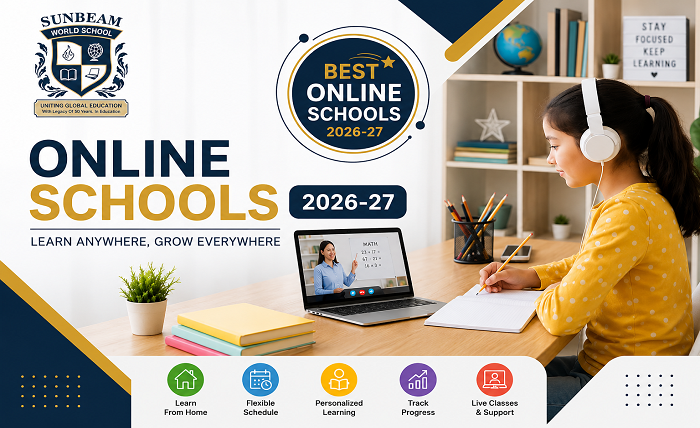
More Indian families are choosing online homeschool for their children, and most of them are not doing it alone with printed worksheets at the kitchen table. They are pairing online homeschool with an accredited school that handles the curriculum, the board registration, and the exams entirely over the internet, while the parent handles the pace and the environment at home.
Nothing here involves a physical campus, a physical tutor visiting the house, or a physical classroom of any kind, since the whole model runs online from admission to certificate. This list compares four such online homeschool providers for 2026-27, starting with the strongest all-round option and moving through three others that each solve a narrower problem well.
Based on parent reviews, academic track record, fee value, and curriculum depth, the best online homeschools in India are: Sunbeam World School, International Schooling, The Virtual School India, and The Real School.
Best Online Homeschool Schools in India at a Glance
| # | School | Grades | Teaching Style | Best For |
| 1 | Sunbeam World School | Pre-primary to Class 12 | Live classes, small batches | Multi-curriculum flexibility |
| 2 | International Schooling | KG to Grade 12 | Self-paced, American curriculum | Families wanting a US diploma |
| 3 | The Virtual School India | Nursery to Grade 8 | Live classes, IGCSE/Cambridge/NCERT | Cambridge-aligned learning from early years |
| 4 | The Real School | Pre-primary to elementary | 1:4 teacher-student model | Highly personalized, project-based learning |
1. Sunbeam World School
Sunbeam World School is the most established name on this list, and for good reason. It covers pre-primary through Class 12, and unlike most online schools that pick one curriculum and stick with it, Sunbeam World School offers multiple pathways under a single admission: the Indian curriculum, NIOS, BOSSE, Cambridge (IGCSE and A-Levels), an American curriculum track, and an Australian curriculum pathway. That matters more than it sounds like it should, since it means a family doesn’t have to guess years in advance which system their child will eventually need for college.
Classes are live and run in small batches at a 2:20 teacher-student ratio. The school also runs three batches a day, morning, afternoon, and evening, so families across different time zones can pick a slot that actually works. Sunbeam World School has built up over 50 years of legacy in K-12 education, which is longer than most names in the online space have existed at all. It’s best suited to families who want recognized, flexible certification without locking into one curriculum too early.
2. International Schooling
International Schooling delivers a full American curriculum from KG through Grade 12, backed by accreditation from Cognia, NEASC, and WASC in the US, and approved by the College Board. It leans toward self-paced learning, supported by a large faculty of internationally trained teachers, and serves students across a large number of countries. It’s a strong fit for families specifically targeting a US-recognized diploma and SAT-aligned coursework, without needing to be based in the US. Since it isn’t tied to NIOS or BOSSE, it works best as a deliberate choice for the American track rather than a stand-in for Indian board certification.
3. The Virtual School India
The Virtual School India covers Nursery through Grade 8, offering IGCSE, Cambridge, and NCERT-based curricula through live, teacher-led classes. What makes it worth knowing is how early it introduces an international pathway, most schools wait until the middle years to offer Cambridge, but this one builds it in from the start. It suits families who know early on that they want a Cambridge-aligned education for their child and don’t want to switch schools later to get there.
4. The Real School
The Real School takes personalization further than most, running on a 1:4 teacher-to-student model instead of the usual batch-class setup, so every teacher works with a maximum of four children at a time. It skips a single-board format in favor of a project-based approach inspired by Montessori and IB-style thinking, with kids learning largely by building, tinkering, and doing rather than sitting through straight lessons. It’s a strong fit for younger children who need close, individual attention and a hands-on style of learning, though families should ask directly about board affiliation and certification for older grades before enrolling.
How Do You Choose the Right Online Homeschool in India?
The right choice usually comes down to three questions, and answering them honestly before enrolling saves a family from switching platforms midway through a school year.
Which Indian Board Actually Fits Your Online Homeschool Plan?
NIOS and BOSSE are the two open boards that make online homeschool certifiable in India, but they are not interchangeable. NIOS is older and more widely recognised by universities, and it suits traditional academic pathways well, while BOSSE is newer, headquartered in Sikkim, and leans toward vocational and NEP-aligned learning, a distinction covered fully in the BOSSE versus NIOS comparison for online homeschool families. A smaller group of families instead target a US-accredited diploma through a school like International Schooling, which sits outside the NIOS/BOSSE system entirely and suits a different long-term goal, usually a US or international college application rather than an Indian one. A family unsure which board fits should confirm acceptance with the specific college or exam their child is likely to target, rather than choosing based on brand recognition alone.
How Independently Does Your Child Actually Learn?
Some children manage self-paced, recorded online content well, while others lose motivation without a live teacher checking in regularly. Online homeschool only works long-term if the delivery style, whether live classes, recorded sessions, or a mix of both, actually matches how the specific child studies, not how the parent wishes the child studied.
Could Your Family’s Plans Change Mid-Way?
A relocation abroad, a shift from an Indian university target to an international one, or a child discovering a new academic strength are all common reasons families change direction. Choosing an online homeschool that offers more than one board under a single admission, rather than a single-board platform, means that change does not force a full withdrawal and re-enrolment elsewhere.
Conclusion
Online homeschooling in India works best when it is treated less like an alternative to school and more like the same recognised education delivered entirely online, backed by the right board and enough live support to keep a child on track. Families who want that flexibility without outgrowing their choice in a year or two can explore Sunbeam World School’s NIOS Class 10 programs as a starting point.